Risks
How Engera records and scores risks, and how the register and matrix views work.
Why a risk register
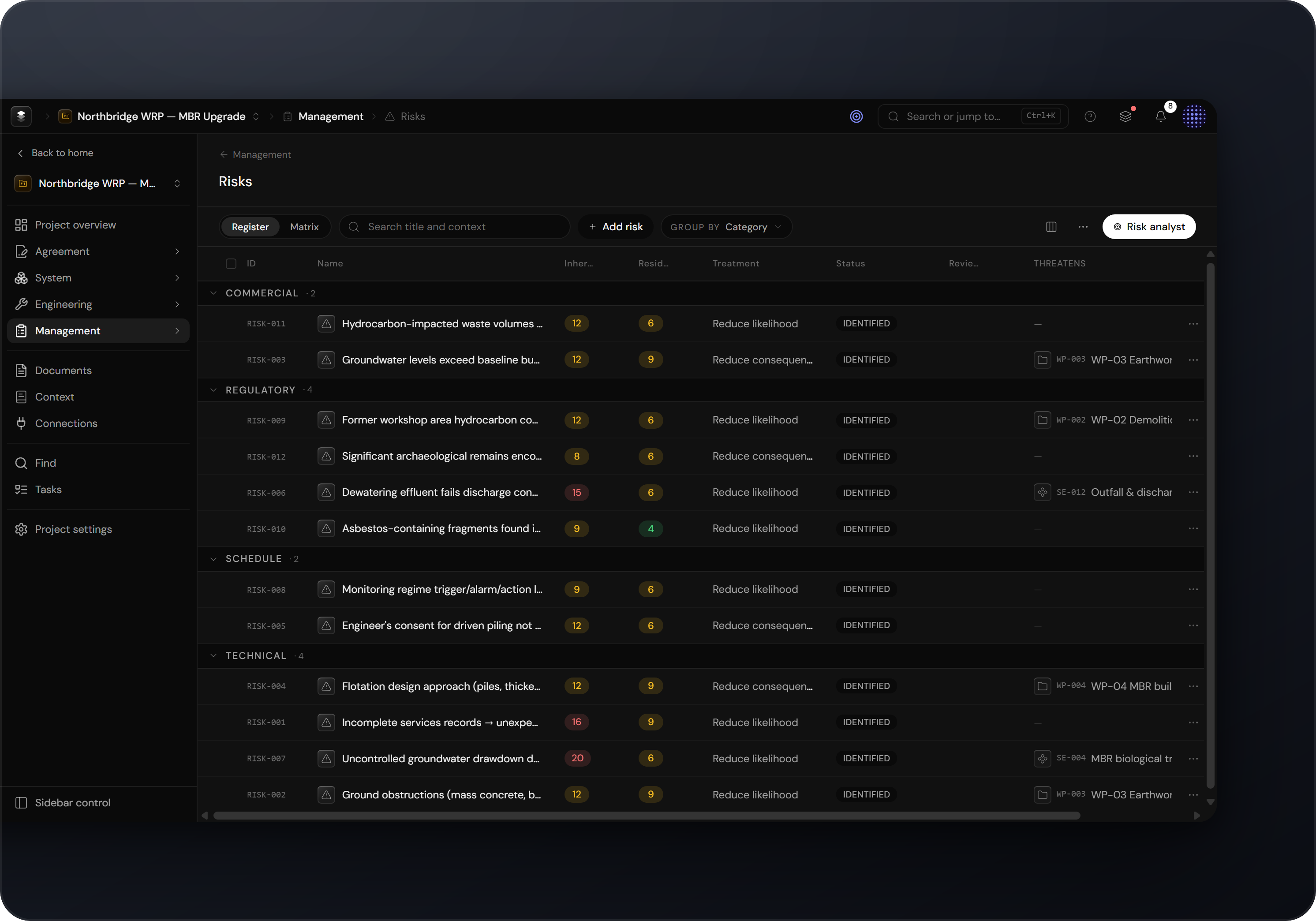
Engera keeps a risk register per project, under Management → Risks, with two views: a table and a likelihood × consequence matrix. Each risk records a score, a treatment, a status and a review date. Risks can be derived from a contract or entered by hand.
How a risk is described
- Likelihood × consequence: each risk is scored on how probable it is and how severe its impact would be. The two multiply into a single risk score.
- Inherent vs residual: the score before treatment and the score expected after it.
- Treatment: the planned response, recorded on the risk.
- Category, status & review date: risks are grouped by theme, carry an open or closed status, and have a review date.
- Source & links: a derived risk links to the clause that revealed it, and can be linked to the items it threatens.
Working with risks
Register shows the risks as a table. Matrix places each risk on a 5 × 5 likelihood-consequence grid by its residual scores; risks without residual scores are listed beside the grid as unassessed.
There are two ways to add risks:
- Derive them from a document. AI-derived risks arrive pending review.
- Click Add risk to enter one by hand.
The risks analyst can assess a contract clause by clause and discuss treatments.